South Korea's ruling party has proposed taxing unrealized gains on stocks and real estate — meaning investors could be taxed on profits they haven't even realized yet.
📉 Haven't sold? Still pay tax.
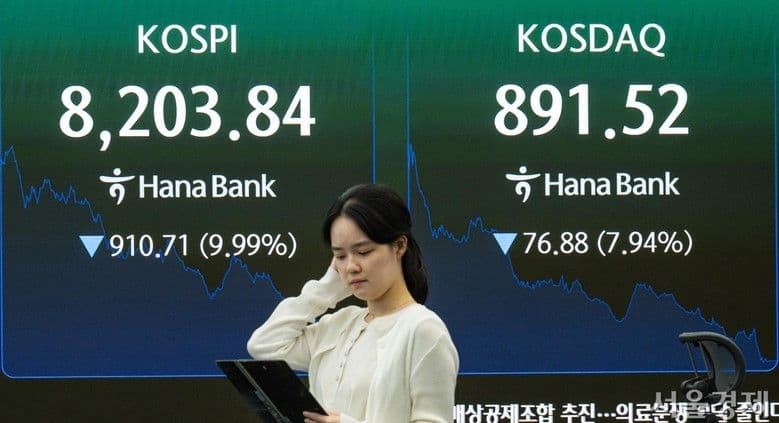
The Market Reaction: The benchmark KOSPI plunged 9.99% on Tuesday, triggering a circuit breaker that halted trading for 20 minutes. Samsung Electronics and SK Hynix both fell over 12% [citation:1][citation:2][citation:3].
According to Yonhap News Agency, on the morning of June 23, 2026, multiple opposition party lawmakers held a tax reform forum in Seoul [citation:5][citation:6][citation:7].
The core proposal: Replace Korea's current tax system with an "Income Tax Comprehensive-ism" framework — where taxation is based on increase in net assets, regardless of whether assets are sold or not [citation:5][citation:6].
Key arguments from forum participants:
- Tax on realization creates a "lock-in effect" — investors hold assets longer to avoid taxes, reducing capital mobility [citation:1][citation:5]
- Tax on unrealized gains would reflect a taxpayer's "economic capacity" more accurately [citation:5][citation:6]
Proposed implementation approach:
- Tax liability deferred until the asset is actually sold (with interest) [citation:5][citation:7]
- Start with high-net-worth individuals and listed financial assets only [citation:5][citation:6]
- Exempt real estate and unlisted stocks from immediate taxation [citation:6]
KOSPI Decline: 910.71 points → -9.99% to 8,203.84 [citation:1][citation:3]
Causes of the crash:
- AI & Tech Sell-off: US tech stocks declined overnight; SpaceX shares fell 16% on corporate bond news; concerns over AI infrastructure costs [citation:2][citation:4]
- Overheated Market: KOSPI had been at record highs; SK Hynix had gained nearly 350% over the past year [citation:15]
- Leveraged Retail Investors: Margin debt hit a record 38.5 trillion won in June; leverage amplified the sell-off [citation:2]
- FII Selling: Foreign investors sold over 4 trillion won of KOSPI shares [citation:3]
- Rumors ("Korea Small Essay"): A social media post claiming Korea's ruling party had officially decided to tax unrealized gains triggered panic among retail investors [citation:5][citation:6]
Circuit Breaker Triggered: At 2:33 PM, the KOSPI slid by over 8%, triggering a Level 1 circuit breaker that halted trading for 20 minutes — the 4th occurrence this year and the 10th in history [citation:3][citation:13][citation:14].
The claim that the Netherlands "passed a similar tax in February 2026 and backtracked days later" is partially accurate — but the timeline is more nuanced.
- What was passed: The "Actual Return in Box 3 Act" passed the Dutch House of Representatives on February 12, 2026 [citation:12]
- The tax: A 36% tax on annual unrealized gains on stocks, bonds, and cryptocurrencies [citation:9][citation:10]
- Why it was passed: The Dutch Supreme Court struck down the previous "deemed return" system in 2021, creating a €2.4 billion revenue gap [citation:9][citation:10]
- The backlash: The bill faced strong criticism from investors, business groups (VNO-NCW), and over 61,000 petition signatures [citation:9][citation:12]
- The reversal: Finance Minister Eelco Heinen admitted "something simply hasn't gone right" and promised major amendments to the bill [citation:11][citation:12]
- Current status: The Dutch Senate has sent 36 pages of questions on the bill; the government is developing amendments to address loss carry-back and startup exemptions [citation:9][citation:12]
Key Concerns Raised:
- Liquidity Risk: Investors may be forced to sell assets to pay taxes on paper gains, creating market pressure [citation:4][citation:11]
- Capital Flight: Wealthy individuals may relocate to lower-tax jurisdictions [citation:11]
- Investment Disincentive: Entrepreneurs and early-stage investors face liquidity crises [citation:4][citation:12]
- Loss Asymmetry: If gains are taxed when assets rise, but losses cannot be claimed back when they fall, taxpayers bear disproportionate burden [citation:9][citation:10]
- Netherlands precedent: 61,000+ signatures, business lobbies, and public outrage forced a government reversal [citation:9][citation:11][citation:12]
In South Korea:
- The proposal was not official government policy — it was a forum discussion [citation:5][citation:6]
- The KOSPI selloff has cooled investor sentiment and forced a reassessment
- Regulatory authorities are monitoring leveraged positions [citation:15]
In the Netherlands:
- The bill is currently under Senate review [citation:9][citation:12]
- Amendments on loss carry-back and startup exemptions are being drafted [citation:9]
- A shift to a traditional realized capital gains tax is possible by 2030 [citation:12]
This publication is solely for informational and educational use. It does NOT constitute investment advice, a research report, or a solicitation to buy/sell securities. The author/publisher is NOT a SEBI-registered Research Analyst. All data sourced from publicly available exchange filings and news reports as of June 23, 2026 (provisional).
Investments in securities are subject to market risks. Past performance is not indicative of future results. Readers are strongly advised to consult a SEBI-registered investment adviser before making any financial decisions.
📞 SEBI SCORES Helpline: 1800 266 7575 | sebi.gov.in
✍️ Written by Rupie Times | 23 June 2026 — Market Wrap: KOSPI @ 8,203.84, Won @ 1,539.1